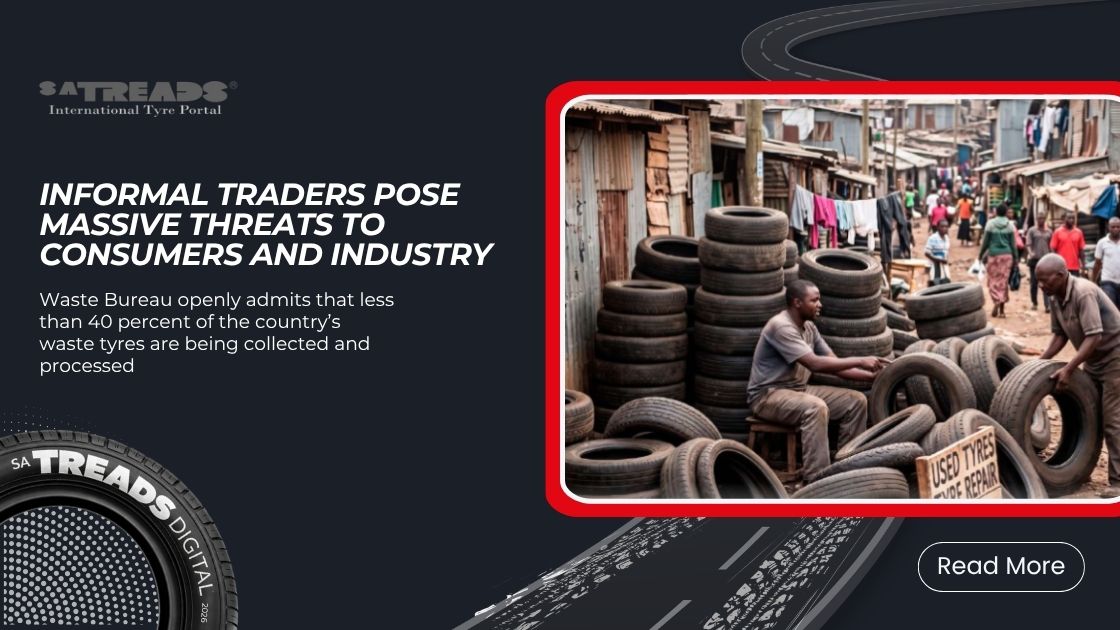
While the regular collection and responsible disposable of used tyres remains largely unaddressed (the Waste Bureau openly admits that less than 40 percent of the country’s waste tyres are being collected and processed), the detrimental effects of this to our environment are not the only concern.
As dealers and end users scramble to remove the growing piles of scrap tyres from their premises, unregistered collectors are only too keen to oblige, arriving in droves to collect them. But where are these waste tyres destined? Most often, they will be sold as second-hands. Which further compounds the matter of illicit trade, as most of these discarded scraps end up in the hands of informal traders, to be sold to unsuspecting consumers, at a fraction of the cost.
The risk to the consumer is obvious. Unknowingly, perhaps, they are compromising road safety, as disused tyres could fail at any given moment. But, what about the detrimental effects to legitimate dealers and franchises? How heavy is the effect of these illicit practices on them?
According to DFFE, an average of 13 million new tyres are sold each year through between 1 400 and 2 000 registered dealerships. Simultaneously, Jenkin estimates that 12 million tyres are entering South Africa’s waste stream annually. It is here, alongside the registered dealerships, that informal second-hand tyre dealers find their consumer markets, plying their trade on the streets of South Africa’s townships, in particular.
Sourcing second-hand tyres
Informal traders have many sources from which to acquire used tyres. Predominantly, they are accumulated from registered dealers or scrap piles at landfill, but more concerning, some registered dealers who sell used tyres, also sell used tyres to informal dealers. This is despite current Waste Tyre Regulations which stipulate that waste tyres should be mutilated and collected by officially appointed transporters to be taken to a depot where waste tyres are stored until processed.
In addition, tyres from vehicles that were in major accidents are sourced from scrapyards. Others are sourced from repossessed vehicles or purchased at auctions, and some are given to them by service garages, that are desperate to dispose of them any way they can.
In one sense, their entrepreneurial flair could be commended. Not only are they supporting themselves (having perceived a gap in the market), but they are providing a ‘service’ to those who cannot afford the price of new tyres. Used tyres typically sell for between R200 and R800 a piece, although BMW drivers could fork out between R1200 and R1500 per tyre for a second-hand tyre – still a mere fraction of the original cost.
Second-hand dealers have become an important source of low-cost tyres, servicing communities comprising many lower-income households. Their clientele is made up of car owners and taxi drivers. Some groups of buyers buy to export to neighbouring countries like Zimbabwe and Mozambique.
Outlining the risks
All well and good, but second-hand tyres are dangerous and unsafe for road use, not to mention the rise in illicit trade is threatening the livelihood of legitimate dealers who play by the book.
Commented one dealer: “Due to unfair trading practices and unlevel playing fields, informal traders are a few steps ahead of the franchise stores which are subject to staff pay, levies and regular inspections.
“In my region alone, there are currently 12 informal traders, with many of the second-hands being offered beyond the manufacturer’s expiry date. Even more concerning, we once saw a scrap tyre that had been mutilated by a dealer, being super-glued together and resold to a customer who was unaware of the danger!”
He added: “Informal traders are having a huge impact on all franchise stores in every region. Bear in mind franchise stores are subject to an annual inspection from the Department of Labour and Health and Safety, but no inspections are taking place with the informal trade. This, despite us regularly highlighting the dangers. The Department’s response? “They are not on our books, so we cannot call on them.”
“Wel feel let down by our manufacturing partners,” said another dealer. “Once their tyres have been sold to the franchise store, it would seem that is the end of their involvement. Not once has one of the manufacturers visited my area and pointed out or registering an official complaint against an informal trader who is not conforming to government standards,” he added.
“It is well known that franchise stores have to meet purchase targets set by the manufacturers, but when a branded franchise store has to compete with the likes of informal traders (most of whom sell second-hand tyres to the consumer as a cheaper option), how does the franchise store meet the quantity requirements of these targets? Every second-hand tyre sold by informal traders is a lost sale for the franchise store.”
Several dealers we spoke with claimed they were relying more and more on Chinese imported tyres in order for their stores to remain open, claiming that price point is still a major factor.
“Manufacturers can come with all their features and benefits, but when a client cannot afford to pay more than R500.00 for a tyre, you cannot be offering them a premium tyre at that price,” said one dealer.
The consensus was: “Manufacturers need to come to the party. History has shown that merely supplying tyres to the franchise store in this ever-competitive market, no longer cuts it. There needs to be more assistance for the franchise stores to stay alive. Shop closures not only affect the franchisee, they impact the manufacturer’s brand awareness in that specific region.”
What is the way forward?
The dealers we spoke with all agreed the playing fields need to be levelled, especially when it comes to store inspections, to which legitimate franchise stores have to conform.
“The local manufacturers have a measure of protection via the SATMC, and the importers have TIASA. What do franchisees have? Nothing. We are on our own,” stated one disgruntled retailer.
“We need to follow European and UK protocol where inspectors are sent to every tyre store, irrespective of whether they are franchises or informal traders,” added another.
“Only then, will legitimate retailers stand a chance to compete and survive.”